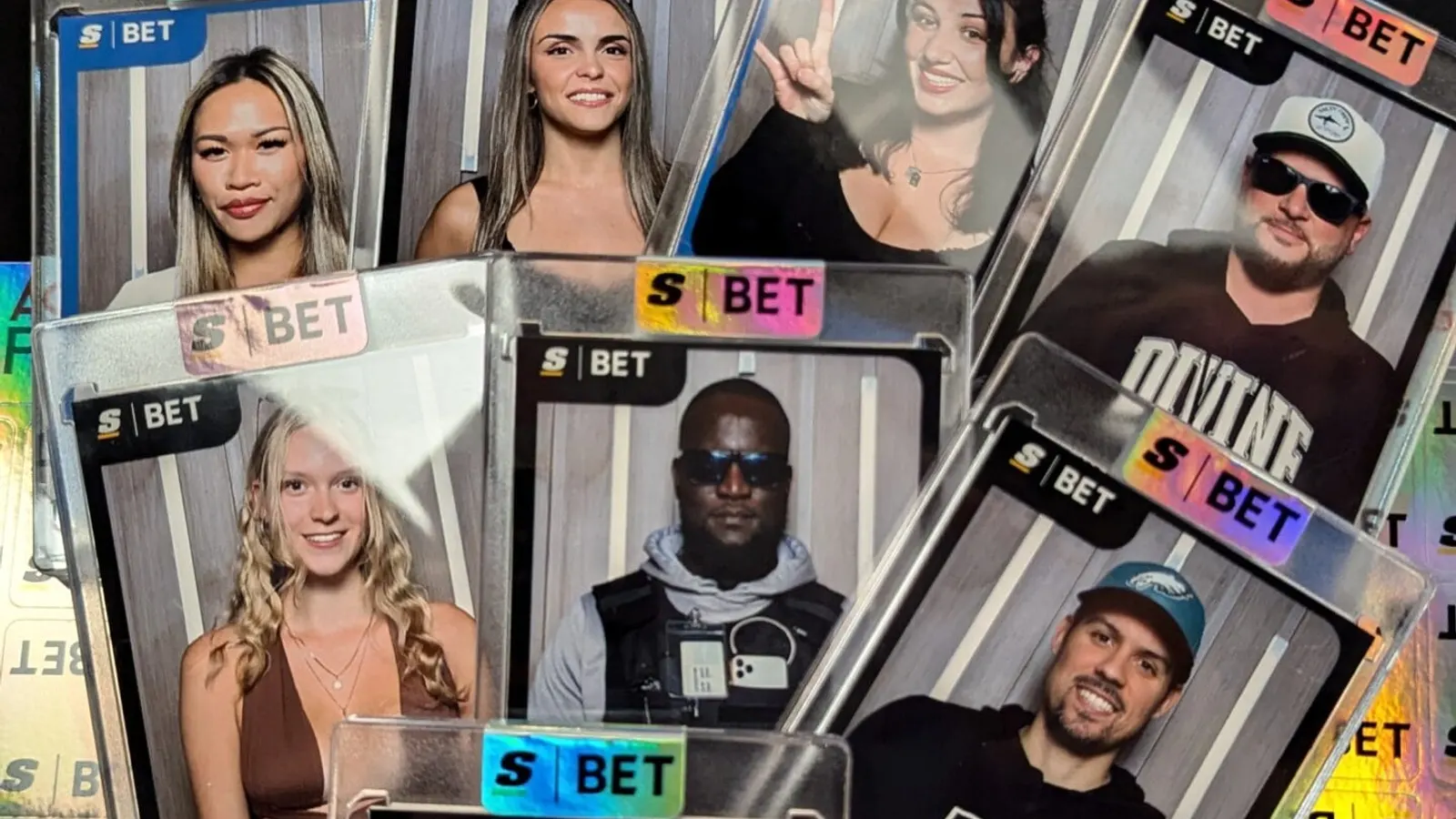
Most event photos are viewed once, shared briefly and eventually forgotten inside a phone gallery.
A custom trading card is different.
It turns the guest into the subject of a personalized collectible, complete with their photograph, name, statistics, character details, company role, special abilities or campaign-specific story.
Instead of receiving another standard branded photo, the guest leaves with something that feels created specifically for them.
A custom trading card photo booth can photograph attendees traditionally or use artificial intelligence to transform them into athletes, heroes, characters, professionals or brand ambassadors. The final design can then be delivered digitally, printed on-site or produced as a premium physical card.
For marketers, the format combines several valuable elements:
- Personalized content
- Physical and digital delivery
- Brand storytelling
- Guest participation
- Sponsor visibility
- Optional lead capture
- Social sharing
- Long-term keepsake value
Trading card experiences are especially effective for sporting events, fan festivals, conferences, product launches, employee programs, retail activations, university events and experiential marketing campaigns.
Personalized trading cards are not a new idea, but brands are finding more creative ways to use them. Upper Deck continues to feature personalized trading card stations at major hockey events, including the 2026 NHL Draft, where fans could create their own cards at the Upper Deck booth. The company has also described its personalized card station as a popular physical-keepsake experience at NHL events and collectibles shows.
This guide explains how custom event trading cards work, why brands use them, what can be personalized, how AI can be incorporated and what marketers should know before planning a trading card activation.
What Is a Custom Trading Card Photo Booth?
A custom trading card photo booth is an interactive event experience that turns each participant into the subject of a personalized card.
The guest poses for a photograph, enters or selects personalized information and receives a finished card designed around the event, campaign or sponsor.
The card might present the guest as:
- A professional athlete
- A draft prospect
- A brand ambassador
- A fictional hero
- A company leader
- A future professional
- A custom action character
- A team member
- A conference speaker
- A product expert
- A campaign personality
- A collectible version of themselves
The card can include more than a photograph.
Depending on the concept, it may feature:
- Guest name
- Jersey number
- Position or title
- Team or department
- Player statistics
- Special abilities
- Character description
- Favourite product
- Company values
- Campaign message
- Event information
- Sponsor logos
- QR codes
- Calls to action
The guest may receive a digital version, a printed card or both.
Some experiences use traditional photography and custom graphic design. Others combine the card format with an AI photo booth, allowing the guest to appear in clothing or environments that were not physically present at the event.
What Is a Trading Card Activation?
A trading card activation is a broader branded experience built around the creation and delivery of personalized cards.
The photo booth is one part of the experience. A complete activation may also include:
- A fully branded booth
- Custom touchscreen screens
- Guest information collection
- Artificial intelligence
- On-site printing
- Card display cases
- Branded packaging
- Sponsor integration
- A digital gallery
- Social sharing
- Live display screens
- Product interaction
- Contest entry
- Campaign reporting
The guest journey can be designed to support a specific marketing objective.
For example, a sports sponsor might transform fans into players. A technology company could turn conference attendees into innovators of the future. A retailer might create cards based on customer style or product preferences.
The card becomes both the output and the campaign mechanic.
Why Custom Trading Cards Work at Events
The strength of a trading card booth is not simply that it prints a different-shaped photo.
The format changes how the guest sees the result.
The Guest Becomes the Main Character
A branded photo normally documents that someone attended an event.
A trading card gives them an identity inside the experience.
They are no longer only posing in front of a sponsor wall. They might become the team’s newest draft pick, a company superhero, a future executive or a character inside the campaign.
That role-based personalization makes the result feel more meaningful.
Cards Feel Collectible
A trading card has a familiar visual language.
People recognize:
- Player portraits
- Names and titles
- Statistics
- Rankings
- Teams
- Special abilities
- Series designs
- Limited editions
- Front-and-back layouts
These elements make the output feel like an object that belongs to a collection rather than a disposable event print.
Physical Cards Extend the Experience
A digital photo can be shared immediately, but a physical card can remain on a desk, shelf, refrigerator, bulletin board or inside a keepsake box.
The sponsor’s branding stays attached to the memory of the event.
The physical item can also create secondary interaction. Guests may compare statistics, trade cards with colleagues or show the result to people who did not attend.
The Format Supports Storytelling
Trading cards naturally combine imagery and information.
The front can deliver the visual impact while the back provides space for:
- Product information
- Campaign messaging
- Event schedules
- Brand values
- Character stories
- Sponsor acknowledgement
- QR codes
- Contest details
This gives marketers more creative space than a basic photo overlay.
The Reveal Is Easy to Understand
Guests immediately understand the value proposition:
Take a photo and become your own trading card.
The idea is clear without requiring a long explanation.
That simplicity is valuable at busy events where attendees are deciding within seconds whether to participate.
How Brands Use Custom Trading Cards at Events
A trading card booth can be adapted to many audiences, but the creative concept should connect naturally to the event.
Sports and Fan Activations
Sports are the most familiar setting for personalized trading cards.
Fans can be presented as:
- Players
- Draft picks
- Coaches
- Broadcasters
- Team captains
- Hall-of-fame inductees
- Championship contenders
- Mascot-inspired characters
The card may include:
- Guest name
- Jersey number
- Position
- Team colours
- Stadium environment
- Player rating
- Speed or power statistics
- Sponsor logo
- Event date
- Custom biography
A fan may be photographed wearing regular clothing and then transformed through AI into an athlete wearing a custom uniform.
Alternatively, the event can provide physical jerseys, helmets, balls or other approved props.
Real examples of the format at work: at theScore Bet’s NFL Kickoff party, guests designed their own NFL-inspired cards sealed in magnetic one-touch cases; at a Skechers Basketball release with Norman Powell in attendance, 64 custom cards were produced in a two-hour influencer window.
Sports sponsors can use the experience to place themselves inside the fan journey rather than simply adding a logo to the edge of a photograph. See our sports event services for more on fan activations.
Brand Sponsorships
A custom trading card activation can connect a sponsor to an event in a way that feels participatory.
Instead of handing out a generic promotional item, the sponsor helps create a personalized collectible.
Potential concepts include:
- Fuelled by the sponsor
- Player powered by the product
- Official fan of the event
- Campaign all-star
- Most valuable customer
- Sponsored draft pick
- Brand ambassador card
- Limited-edition fan card
The sponsor can appear in the card artwork, physical booth, packaging, digital delivery page and call to action.
Brand integration should remain intentional. When every part of the card is covered in logos, it may stop feeling like a personal collectible and begin to feel like an advertisement.
Product Launches
A trading card can introduce a new product by making the guest part of its story.
For example:
- A footwear brand could create athlete cards based on speed and style.
- A technology company could assign futuristic abilities related to product features.
- A beverage company could create flavour-based characters.
- A beauty brand could produce editorial cards based on different campaign looks.
- An automotive brand could turn guests into drivers inside custom environments.
- A travel company could create destination explorer cards.
The card’s statistics and descriptions can communicate product benefits in a playful format.
Instead of listing features conventionally, the campaign can convert those features into attributes, powers, ratings or character traits.
Conferences and Trade Shows
At a conference or trade show, a trading card booth can attract visitors while producing content connected to the event theme.
Potential concepts include:
- Innovator of the future
- Industry all-star
- Conference rookie card
- Technology leader
- Cybersecurity defender
- Future executive
- Speaker card
- Exhibitor card
- Professional superpower
- Custom networking card
The back of the card may include a QR code directing attendees to:
- A product demonstration
- Landing page
- Contest
- Meeting scheduler
- Downloadable resource
- Exhibitor information
- Conference agenda
The experience can also become a networking tool. Attendees might collect cards from speakers, team members or selected participants.
Employee Events
Custom trading cards can turn employee recognition into something more playful and personalized.
Employees might receive cards highlighting:
- Job title
- Department
- Years of service
- Special skill
- Company achievement
- Employee award
- Team value
- Personal motto
- Workplace superpower
This works well for:
- Company anniversaries
- Holiday parties
- Sales conferences
- Leadership summits
- Employee appreciation events
- Internal product launches
- Awards nights
- Team-building programs
A card series can also recognize different departments or locations while keeping the overall company design consistent.
Recruitment and Employer Branding
A recruitment-focused card can help a company communicate possible career paths.
Guests may be transformed into:
- Future engineers
- Healthcare leaders
- Creative professionals
- Technology specialists
- Executives of the future
- Skilled-trade professionals
- Company innovators
The card can include information about the role, workplace culture or relevant career opportunities.
At university recruitment events, the card provides a personalized takeaway while giving recruiters a natural starting point for conversation.
Retail and In-Store Activations
Trading card booths can increase dwell time inside stores, malls and temporary retail experiences.
The card may be connected to:
- A product launch
- Seasonal campaign
- Celebrity collaboration
- Sports partnership
- Fashion collection
- Store opening
- Customer loyalty program
- Limited-edition release
A premium display case or branded sleeve can make the takeaway feel more like merchandise than an event print.
The experience can also encourage guests to visit a product display or complete another part of the campaign before receiving the card.
Universities and Student Events
Trading cards are a strong fit for student orientation, athletics, alumni events and campus programs.
Possible concepts include:
- First-year rookie cards
- Faculty all-stars
- Graduation cards
- Campus club cards
- Student-athlete cards
- Alumni legends
- Program-specific characters
- Future career cards
Statistics can be humorous or meaningful:
- Campus energy
- Study endurance
- Coffee consumption
- School spirit
- Teamwork
- Creativity
- Leadership
The experience gives students an immediate icebreaker and a physical reminder of the event.
Festivals and Public Events
At festivals, trading cards can turn attendees into characters connected to the event theme.
Possible formats include:
- Music artist cards
- Festival performer cards
- Fantasy characters
- Community heroes
- Food critic cards
- Local landmark cards
- Cultural celebration cards
- Limited-edition event series
A series-based design can encourage repeat participation across multiple event days or locations.
Entertainment and Fan Conventions
Comic, gaming, film and entertainment events already have strong collecting cultures.
Guests can become:
- Original heroes
- Villains
- Fantasy characters
- Space explorers
- Game avatars
- Action figures
- Character-class cards
- Convention exclusives
The creative direction should use original artwork unless the organizer has secured permission to use protected entertainment properties.
Traditional Photography vs. AI Trading Cards
A custom card can use a conventional photograph or an AI-generated image.
Each approach has advantages.
| Traditional Trading Card | AI Trading Card |
|---|---|
| Shows the guest as photographed | Transforms the guest into a new character or environment |
| Faster and more predictable | More visually dramatic and personalized |
| Works well with physical props and uniforms | Can create clothing and settings digitally |
| Better suited to groups | Often strongest for individuals |
| Lower processing requirements | Requires generation time and reliable technology |
| Easier to approve for conservative brands | Requires additional testing and brand controls |
| Consistent across high guest volumes | Quality can vary between generations |
Use traditional photography when:
- Guest volume is extremely high
- Physical uniforms or props are available
- Group photographs are important
- The brand wants a realistic image
- Internet access is limited
- Processing speed is the primary concern
- Consistency matters more than transformation
Use AI when:
- The guest should become a character
- Custom clothing or environments are needed
- Physical set construction would be impractical
- Personalization is central to the campaign
- The final card needs a dramatic reveal
- The brand wants several themed options
Some experiences combine the two. The guest is photographed professionally, while AI changes only selected elements such as the uniform, background or character styling.
Explore Booth Empire’s AI Photo Booth rental service or read our complete AI Photo Booth Rental Guide for a deeper explanation of AI-generated event photography.
What Can Be Personalized on a Trading Card?
A successful custom trading card should feel specific to the person while remaining visually consistent with the campaign.
Guest Name
The guest’s name is one of the simplest and most effective personalization elements.
It can be entered:
- On the touchscreen
- During registration
- By an attendant
- Through a QR form
- From a preloaded guest list
Names should be reviewed before printing. A confirmation screen can reduce spelling errors.
Title, Position or Character Class
The card might display:
- Forward
- Goalkeeper
- Team captain
- Innovator
- Creative director
- Brand hero
- Product expert
- Future leader
- Campus rookie
- Customer all-star
The title should reinforce the campaign concept.
Statistics and Ratings
Statistics make the card interactive and entertaining.
Examples include:
- Speed
- Power
- Creativity
- Leadership
- Teamwork
- Style
- Endurance
- Innovation
- Fan energy
- Coffee level
- Celebration rating
- Product knowledge
Statistics may be:
- Selected by the guest
- Assigned randomly
- Generated from a short quiz
- Connected to a physical challenge
- Based on event registration information
- Written as humorous fixed values
Avoid collecting unnecessary personal information merely to populate the card.
Number or Ranking
A jersey number, issue number or ranking can make the card feel more authentic.
Examples include:
- Favourite number
- Year of graduation
- Employee anniversary year
- Event date
- Session number
- Limited-edition number
- Product model
- Campaign code
Avoid claiming that a card is genuinely limited or individually numbered unless the production process supports that claim.
Biography or Character Description
The back of the card can include a short biography such as:
Known for creative problem-solving and championship-level teamwork.
The biography may be:
- Prewritten
- Selected from approved options
- Generated from a questionnaire
- Produced through a controlled AI workflow
- Based on the guest’s department or role
Corporate AI-generated text should be tested and moderated before printing.
QR Code
A QR code can direct the guest to:
- Their digital image
- Event gallery
- Product page
- Contest entry
- Campaign video
- Social media page
- Discount offer
- Registration form
- Meeting scheduler
The QR destination should be mobile-friendly and remain active for the promised period.
Sponsor and Campaign Information
Brand elements can include:
- Sponsor logo
- Event name
- Campaign hashtag
- Product message
- Legal line
- Website
- Call to action
- Location
- Event date
Branding should support the design rather than compete with the guest’s image.
What Should Go on the Front and Back?
A double-sided card provides more creative flexibility than a standard photo print.
The Front of the Card
The front should deliver immediate visual impact.
It may include:
- Guest portrait
- Guest name
- Team or character name
- Position or title
- Jersey number
- Campaign logo
- Event branding
- Foil-style graphic effects
- Edition name
Avoid placing too much small text on the front. The card should still be legible when photographed or shared online.
The Back of the Card
The back can carry more information.
It may include:
- Personalized statistics
- Character biography
- Company values
- Product information
- Sponsor message
- QR code
- Website
- Social handles
- Event details
- Legal disclosures
- Contest rules link
The back should still feel designed, not like a block of promotional fine print.
Digital, Printed or Premium Cards?
The best delivery format depends on the campaign objective, budget and guest volume.
Digital Trading Cards
A digital card can be delivered through:
- QR code
- Text message
- Event gallery
- Mobile microsite
Advantages include:
- Faster distribution
- No physical supplies
- Easy social sharing
- Multiple card variations
- Simple campaign linking
- Lower shipping requirements
- Easier delivery at multi-city events
Digital delivery is often the best choice for extremely high-volume programs.
Printed Paper or Photo Cards
Printed cards provide an immediate physical takeaway.
They may be produced on:
- Photo media
- Heavy card stock
- Laminated stock
- Specialty paper
- Magnetic material
The print should be tested for:
- Colour accuracy
- Text size
- Durability
- Drying or finishing time
- Front-and-back alignment
- Fingerprint resistance
A standard photo printer may produce a card-shaped design on a larger print, while specialized equipment may produce a more traditional card format.
PVC Trading Cards
PVC cards create a thicker, more durable result similar to an identification or membership card.
They can feel more premium and may be suitable for:
- Major sponsorships
- Multi-day campaigns
- VIP experiences
- High-profile sports events
- Product launches
- Collectible series
PVC production usually requires a different workflow from standard photo printing.
The event planner should confirm:
- Production speed
- Card thickness
- Print quality
- Whether both sides are printed
- How cards are cut or finished
- Whether cards are produced live or completed later
- Replacement procedures
Display Cases and Protective Packaging
Cards can be placed inside:
- Clear sleeves
- Rigid holders
- Magnetic display cases
- Branded envelopes
- Custom folders
- Lanyard holders
- Collector-style packaging
A protective case can increase perceived value, but it also adds cost and handling time.
Do not describe a decorative display case as professional card grading or certification unless the card has actually been evaluated by an authorized grading service.
How Does a Trading Card Photo Booth Work?
A well-designed guest journey should be simple.
1. The Guest Approaches the Booth
Signage or an attendant explains the concept.
The guest should quickly understand:
- What they will become
- What information is needed
- Whether AI is involved
- How long the process takes
- Whether the card is digital or physical
- How the image may be used
2. The Guest Enters Their Information
The guest may enter:
- Name
- Number
- Position
- Team
- Character option
- Selected statistic
- Email or phone number
Only information needed for the experience should be collected.
3. The Guest Selects a Card Style
Some campaigns offer one universal design.
Others allow the guest to choose:
- Team
- Character
- Product
- Department
- Uniform
- Background
- Card rarity
- Visual theme
Choices can increase participation but may also slow down the line.
4. The Guest Is Photographed
The photography style should match the final card.
Possible approaches include:
- Close portrait
- Waist-up photograph
- Full-body pose
- Action pose
- Prop interaction
- Product pose
- Group photograph
An attendant should provide quick posing guidance.
5. The Image Is Processed
The workflow may:
- Remove the background
- Add branded artwork
- Apply colour treatment
- Insert guest information
- Generate an AI transformation
- Create statistics
- Build the front and back
- Add a QR code
6. The Card Is Reviewed
Depending on the event, the guest may review:
- Their name
- Selected number
- Photograph
- Card theme
- Final result
A review screen can reduce reprints caused by spelling or selection errors.
7. The Card Is Delivered
The guest receives:
- A digital file
- A printed card
- A PVC card
- A card in protective packaging
- A combination of physical and digital outputs
A separate pickup area may help prevent congestion around the camera.
Guest Throughput and Line Management
Trading card activations involve more steps than a basic photo booth.
The complete process may include:
- Explanation
- Information entry
- Theme selection
- Photography
- Background removal or AI generation
- Card assembly
- Printing
- Packaging
- Pickup
- Digital delivery
Every step affects capacity.
Event planners should ask the provider for a realistic hourly estimate based on the exact workflow.
Factors affecting throughput include:
- Number of text fields
- Number of card options
- Individual or group photography
- AI generation time
- Front-only or double-sided printing
- Printer speed
- Packaging
- Number of attendants
- Number of capture stations
- Number of printers
- Guest review
- Retakes
For large events, the setup may require:
- Multiple capture stations
- Multiple printers
- Pre-registration
- Simplified card choices
- Fixed statistics
- Separate pickup counters
- Additional attendants
- Digital delivery during peak periods
- Timed participation
- VIP and general lines
Upper Deck’s own descriptions of personalized trading card experiences have repeatedly warned fans that lines can become long, illustrating why capacity planning matters when the output is highly desirable.
How Much Space Does a Trading Card Booth Require?
The footprint depends on the capture and printing workflow.
A basic setup may include:
- Photo booth or camera
- Lighting
- Guest posing area
- Touchscreen
- Printer station
- Processing computer
- Pickup counter
- Supply storage
- Queue
An area of roughly 8 feet by 8 feet may work for a simple booth, but a high-volume trading card activation may require significantly more room.
Additional space may be needed for:
- Multiple printers
- PVC card production
- Packaging
- Product displays
- A branded backdrop
- Queue barriers
- A separate pickup station
- Multiple photography stations
- Staff worktables
The booth should not block emergency routes, food service, venue entrances or neighbouring exhibitors.
Internet and Power Requirements
The exact requirements depend on the equipment.
Internet may be needed for:
- AI image generation
- Digital delivery
- QR galleries
- Lead capture
- Cloud storage
- Analytics
- Remote support
A traditional photo-and-print workflow may be able to continue locally if internet service is interrupted.
Event planners should ask:
- Can cards still be created without internet?
- Can digital deliveries be queued?
- Does the provider supply backup connectivity?
- Is venue Wi-Fi sufficient?
- Is wired internet available?
Power may be required for:
- Camera
- Lights
- Computers
- Photo printers
- PVC printers
- Display screens
- Network equipment
Large printer or multi-station setups may require dedicated electrical circuits.
Lead Capture, Privacy and Consent
A trading card activation can collect useful campaign data, but the process must remain transparent.
Possible information includes:
- Name
- Phone number
- Card selection
- Product interest
- Event location
- Marketing consent
Receiving the card and agreeing to future marketing should be presented as separate choices.
The Office of the Privacy Commissioner of Canada advises organizations to clearly explain what personal information is collected, why it is collected, who it will be shared with and what choices the person has. Canadian commercial emails and marketing texts are also subject to CASL requirements, including consent, sender identification and an unsubscribe mechanism.
The guest interface should explain:
- What information is required
- Why it is needed
- How the card will be delivered
- How long information will be stored
- Whether the organizer receives the data
- Whether the image may be used publicly
- How consent can be withdrawn
For youth events, the organizer should establish an appropriate consent process before the event.
Brand Safety and Intellectual Property
Custom card designs should be original unless the organizer has permission to use protected assets.
Potentially protected elements may include:
- League logos
- Team names
- Uniforms
- Player likenesses
- Entertainment characters
- Game artwork
- Celebrity images
- Brand marks
- Existing trading card templates
- Copyrighted backgrounds
A card can be inspired by the general visual language of sports collectibles without copying a specific Topps, Upper Deck, Panini or other protected design.
For an unlicensed sports concept, consider using:
- Original team names
- Campaign-specific uniforms
- Approved sponsor colours
- Fictional statistics
- Original card borders
- Custom iconography
- Generic stadium environments
The client’s legal or brand team should approve the final artwork when licensed properties, sponsorship assets or public personalities are involved.
Measuring a Trading Card Activation
The right success metrics depend on the campaign objective.
Participation Metrics
- Total sessions
- Total participants
- Cards created
- Cards printed
- Digital cards delivered
- Repeat participation
- Participation by hour
- Most popular card style
Operational Metrics
- Average processing time
- Printer output
- Reprint rate
- Failed AI generations
- Peak queue length
- System uptime
- Cards produced per hour
Digital Metrics
- QR scans
- Email deliveries
- Text deliveries
- Image downloads
- Gallery visits
- Landing-page traffic
- Social shares
Marketing Metrics
- Optional leads collected
- Marketing opt-ins
- Contest entries
- Product interactions
- Scheduled meetings
- Offer redemptions
- Campaign conversions
Brand Metrics
- User-generated content
- Hashtag usage
- Sponsor visibility
- Influencer participation
- Qualitative guest feedback
The organizer should define the desired outcome before deciding which information to collect.
How Much Does a Custom Trading Card Activation Cost?
Custom trading card booths are normally quoted according to the specific project rather than a single universal rental price.
Pricing may be affected by:
- Event duration
- Number of event days
- Expected guest volume
- Digital or physical delivery
- Paper, photo or PVC cards
- Single-sided or double-sided design
- Number of card styles
- Artificial intelligence
- Custom creative development
- Booth interface design
- On-site staffing
- Number of capture stations
- Number of printers
- Protective packaging
- Booth wrapping
- Backdrop
- Travel
- Shipping
- Internet
- Lead capture
- Post-event reporting
The expected number of cards is one of the most important planning variables.
A small executive event producing 100 premium cards requires a different setup from a stadium program expected to serve more than 1,000 fans.
When comparing proposals, confirm whether the quote includes:
- Card design
- Test prints
- Printing supplies
- Packaging
- Photography
- AI development
- Staff
- Setup
- Teardown
- Travel
- Reprints
- Digital files
- Reporting
- Overtime
How Far in Advance Should Brands Plan?
A straightforward card using an existing format may require limited preparation.
A fully branded trading card campaign may require several weeks for:
- Creative development
- Card design
- AI testing
- Brand approval
- Legal review
- Print testing
- Data-field setup
- Interface design
- Packaging production
- Venue coordination
- Shipping
- Staff scheduling
A practical timeline may look like this:
Eight or More Weeks Before the Event
- Define the campaign objective
- Select the provider
- Estimate guest volume
- Choose card material
- Establish the creative concept
- Identify required approvals
Six Weeks Before the Event
- Review initial card designs
- Confirm personalized fields
- Decide whether AI will be used
- Confirm physical packaging
- Review privacy requirements
Four Weeks Before the Event
- Approve artwork
- Test photography and AI output
- Produce sample cards
- Confirm printer capacity
- Review the guest journey
Two Weeks Before the Event
- Finalize signage
- Confirm internet and power
- Confirm load-in
- Approve consent language
- Test QR codes
- Confirm quantities and supplies
Event Week
- Verify final artwork
- Confirm guest lists when applicable
- Reconfirm venue contacts
- Review backup plans
- Test all equipment
Large-scale, multi-city or licensed campaigns should begin earlier.
Questions to Ask a Trading Card Photo Booth Company
Creative and Design
- Is the card design completely custom?
- Is front-and-back design available?
- How many card variations are included?
- Can guests choose their team or character?
- How many artwork revisions are included?
- Can our legal and brand teams review samples?
Photography and AI
- Does the booth use traditional photography or AI?
- How is the background removed?
- How is guest likeness maintained?
- Can groups participate?
- What happens when an AI image fails?
- Can we offer a non-AI option?
Printing
- What material is used?
- Are cards printed on-site?
- Are both sides printed?
- How durable are the cards?
- What size are they?
- How many can be produced per hour?
- Are protective cases available?
- How are reprints handled?
Guest Flow
- How many steps are involved?
- How many guests can be served per hour?
- How many attendants are included?
- Is there a separate pickup area?
- Do you recommend multiple stations?
- Can guest details be preloaded?
Branding and Rights
- Can sponsor logos be included?
- Can the booth be wrapped?
- Can licensed team assets be used?
- Who is responsible for securing permissions?
- How do you avoid copying existing card brands?
Technology
- Is internet required?
- What power is needed?
- Is backup connectivity supplied?
- Can the booth continue during an outage?
- Is backup printing equipment available?
Data and Reporting
- What guest data is collected?
- Where is it stored?
- Is marketing consent optional?
- Can the organizer access the gallery?
- What reporting is provided?
- How long are images retained?
Pricing
- Is creative development included?
- Are all cards and supplies included?
- Is packaging included?
- Are travel and shipping included?
- What is the overtime rate?
- What happens if more cards are required?
Common Trading Card Activation Mistakes
Treating the Card Like a Resized Photo
A trading card should use the format creatively.
Simply placing a portrait inside a card-shaped border misses the opportunity to add identity, statistics, storytelling and collectibility.
Copying an Existing Card Design
The card should feel familiar without reproducing protected layouts, logos or visual elements.
Create an original series that belongs to the campaign.
Adding Too Many Personalized Fields
Every field adds time and another opportunity for error.
Ask only for details that make the card meaningfully better.
Ignoring Production Capacity
A successful booth may attract a substantial line.
Plan the number of cameras, printers, attendants and pickup stations around realistic demand.
Using Text That Is Too Small
A design may look excellent on a large monitor but become unreadable on a physical card.
Always review printed samples at actual size.
Overbranding the Card
Guests are more likely to keep and share a card that feels personal.
Keep the participant as the focus and integrate sponsor branding strategically.
Skipping Print Testing
Colours, small text, double-sided alignment and image sharpness should all be tested before the event.
Calling a Decorative Case a Graded Slab
A protective holder can look premium, but it should not be presented as professional card grading or authentication.
Hiding Marketing Consent
Guests should know whether they are receiving only their card or also joining a marketing list.
Forgetting the Back of the Card
The back provides valuable space for statistics, campaign messaging and QR codes.
Leaving it blank can be a missed creative opportunity.
Why Choose Booth Empire for Custom Event Trading Cards?
Booth Empire creates personalized trading card experiences for corporate events, sporting events, brand activations, festivals, conferences and multi-city campaigns - from 400+ player-style cards in six hours for Zynga at a student gaming event to a compact, backdrop-free in-store activation for PUMA x JD Sports on Robson Street.
Depending on the project, a Booth Empire trading card activation can include:
- Custom front-and-back card design
- Professional photography
- AI-generated transformations
- Personalized guest names
- Custom statistics
- Team and character selections
- Digital card delivery
- On-site printing
- Premium PVC cards
- Protective card holders
- Branded booth interfaces
- Sponsor integration
- Custom booth wrapping
- Branded backdrops
- Optional lead capture
- Event galleries
- Post-event reporting
- Multiple capture stations
- High-volume production planning
- Destination-event support
We begin with the campaign objective.
From there, we determine:
- What the guest should become
- What information belongs on the card
- Whether traditional photography or AI is most appropriate
- Which material fits the budget and expected volume
- How many guests need to be served
- How the card will be delivered
- How branding should appear
- What should happen after the guest receives it
The goal is not simply to print an attendee’s photograph in a smaller format.
The goal is to create a personalized collectible that connects the guest to the event, brand or sponsorship.
Explore Booth Empire’s custom trading card services or see a real brand activation case study for an example of how this works in production. We deliver custom trading card programs across Toronto, Niagara, Hamilton, London, Montreal, Vancouver, Buffalo and other destinations throughout Canada and the United States. Contact us to discuss a custom event trading card campaign.
Create a Custom Trading Card Activation
A custom trading card photo booth turns the guest into something more than an event attendee.
They become the player, character, professional, hero or ambassador at the centre of the campaign.
The strongest trading card activations combine:
- A clear creative concept
- Personalized photography
- Thoughtful card design
- Efficient guest flow
- Reliable printing
- Strategic sponsor integration
- Responsible data collection
- A physical or digital result worth keeping
Whether you are planning a sporting event, fan festival, conference, product launch, employee celebration, recruitment program or multi-city brand campaign, Booth Empire can create a custom trading card experience around your audience and objectives.
Request a custom trading card activation quote and tell us who you want your guests to become.